
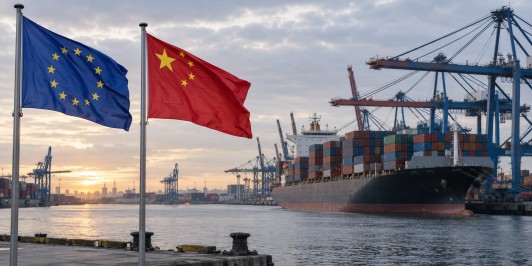
The European Union’s escalating trade deficit with China is prompting Brussels to consider significant measures to restore balance in their economic relationship. As of July 2026, the EU’s trade deficit with China has reached a staggering €36.5 billion, highlighting the bloc’s growing reliance on Chinese imports, particularly in strategic sectors such as hybrid vehicles and chemicals.
According to recent data from Eurostat, EU imports from China surged by 8% year-on-year, amounting to €53.9 billion in July. In stark contrast, exports to China decreased by 1.6%, totaling €17.4 billion. This growing disparity has intensified from the previous year’s deficit of €32.3 billion in July 2025. Cumulatively, from January to July 2026, the EU’s trade deficit with China has ballooned to approximately €234 billion.
In response to this widening gap, European officials are under mounting pressure to address trade imbalances. As part of these efforts, Brussels is contemplating measures targeting imports, particularly in the hybrid vehicle sector. This move comes after an increase in hybrid vehicle imports from China, spurred by the EU’s 2024 additional tariffs on Chinese electric vehicles, which did not apply to hybrids.
The focus on hybrid vehicles reflects broader trade tensions between the EU and China. European leaders are exploring the possibility of voluntary limits on Chinese hybrid vehicle exports. These discussions are expected to feature prominently in upcoming EU-China negotiations, as the EU seeks to enhance its exports and reduce dependency on Chinese goods in critical industries.
Trade relations between the EU and China remain a critical issue, with the bloc striving to recalibrate its trade strategy. As Brussels seeks to boost European exports and address the ongoing trade imbalance, the future of EU-China economic ties will likely hinge on the outcomes of these strategic discussions.